theonlyD800inthehameau
Photography by theonlydeadheadinthehameau
Symmetry
Posted on January 13, 2016
Something in the human brain is attracted to symmetry; we find it – almost always – aesthetically pleasing. And, as Cee points out this week, it can appear in many different guises.
To begin with, here are two images from the Sheikh Zayed Grand Mosque in Abu Dhabi. The first is yet another (no apologies though) chandelier, pictured from below, which is an example of circular symmetry, while the second is the top of a dome, which is obviously an example of left/right symmetry.


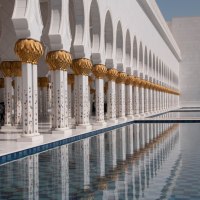
Although symmetry is an important element of Islamic art, it also features extensively in secular situations in Arab countries. Here is part of the seawall on the Abu Dhabi Corniche and – more prosaically – the underground carpark of the Dubai Mall.


It’s also possible to see symmetry in multiple subjects: like these two conjoined kites from the Blond airshow and a set of measuring jugs from a museum in Sarlat.


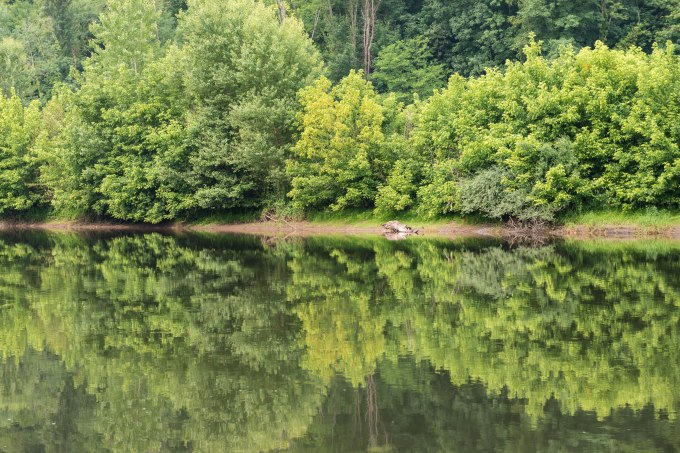
And finally, the symmetry of reflections on the Dordogne River
Perspective
Posted on January 7, 2016
Four images that demonstrate the theme of perspective for Cee’s Compose Yourself Photo Challenge this week:

This detail of an old dhow drawn up on the waterfront in Abu Dhabi contrasts with the modern skyscrapers in the background.
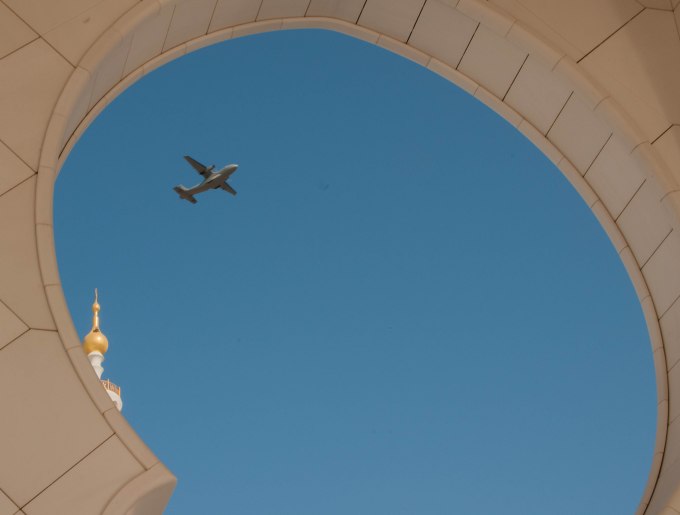
Still in Abu Dhabi, this aircraft was flying over the Sheikh Zayed Grand Mosque when I happened to be there.
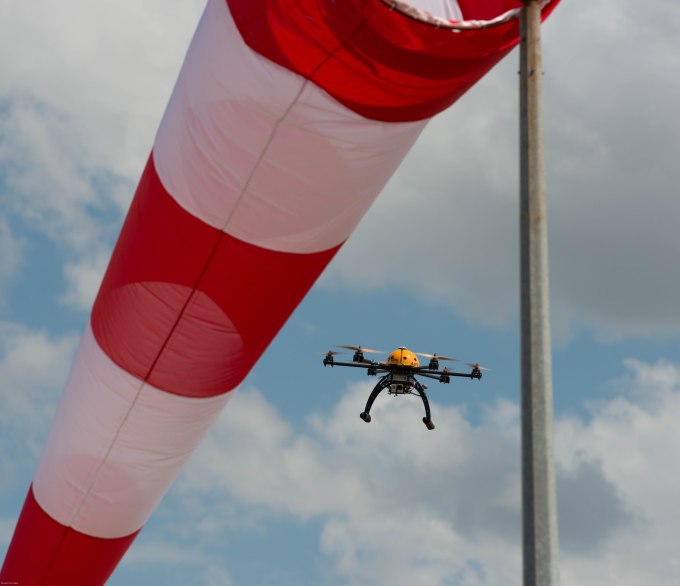
The red and white striped windsock at the Blond airstrip is a striking image in itself, but so is the drone behind it.

From a photographic perspective you can debate whether it’s the baby or the cake that’s the subject of this picture, but there’s only one subject that my grandson was interested in on his first birthday.
Lessons learnt
Posted on December 31, 2015
This week, as part of her ongoing Compose Yourself Challenge, Cee Neuner has offered up five of her own photographs for participants to offer a critique and, if they choose, edit themselves. I like to think that I can take it as well as dish it out, so although it seems a little churlish to ‘have a go’ at the work of someone who does so much for the photoblogging community, I’m going to take up the offer. It’s at times like this it’s important to remember that there’s all the difference between critique and criticism.
As Cee points out, all five of these images are straight out of the camera, with no post-processing whatsoever. In my view, there’s something that can be done with three of them, although with ‘Coloured Chairs’ and ‘Taxi Cab’ I’d just be inclined to press ‘delete’ and move on. Perhaps they illustrate Cee’s dictum that you should never take just one photo.
As for the others, I’ve done my own editing on them and present the before and after side by side, with a few notes on what I did and why.
Marina


- Photography 101: Horizons should be horizontal
- The setting sun is blown out, and the rest of the image is underexposed. I cropped out the left hand side to eliminate the glare and also whatever it is at top left (it surely isn’t the subject).
- Moving around the sliders lightened the remaining image, bringing out more detail in the foreground as well as enhancing the colour of the sky.
Red Umbrella


Anything red is pretty much guaranteed to make a good subject (as well as the classic foreground object), but in the original the umbrella is a bit lost somewhere in the middle, so I cropped it to put the umbrellas in the left third of the image, and also bring out the diagonals of the wall and pavement (sorry, ‘sidewalk’). A bit of punch from boosting Clarity and Vibrance and I think you have an interesting image.
Doors


- This is a fascinating door, although I think the image would work better if it was taken from directly in front (a problem I always have) as it’s impossible (at least within my limited abilities) to get all the verticals in the image properly vertical. I’ve straightened it as far as I could.
- I also cropped to remove the distractions on the left side.
- The picture was obviously taken in bright sunlight so looks a little washed out. I adjusted exposure by -1 stop and played around with the tone curve to increase contrast and detail, and also enhance the colour of the door.
Centred
Posted on December 16, 2015
This week we focus on images that, with a healthy disregard for the rule of thirds, are intended to be placed in the middle of the frame: to be literally the centre of attention.
This image was taken looking down a corridor in the cellars of a wine-producing chateau in the Bordeaux region:

Flowers are a very obvious ‘centre-friendly’ subject – particularly when photographing buds, before the petals start to compete for space in the frame:


Also, of course, anything circular has an obvious central focus, be it wheels or even fireworks:


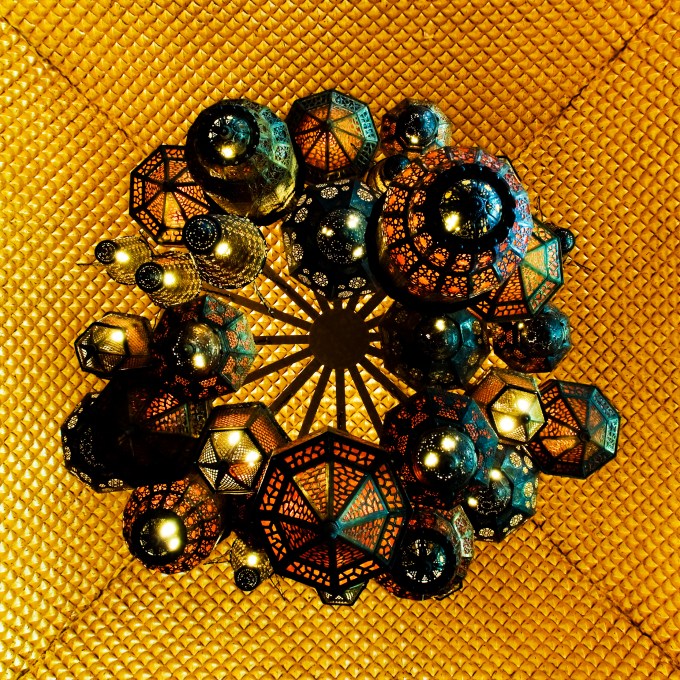
And finally this is just one of my most favourite images: it was taken looking directly upwards to the ceiling of the reception area of the Sir Bani Yas Hotel in Abu Dhabi. Those lanterns are between six and eight feet high when you see them sideways on from the second floor.
Rule of Thirds (2)
Posted on December 10, 2015
To be honest, finding ‘ready-made’ images that occupy two-thirds of the picture was a bit of a challenge. That probably just goes to show that I am (or was) too wedded to sticking the subject in the middle of the photograph as a matter of course. Still, a bit of creative cropping did the job.
This week, I have three pairs of similar images illustrating the 2/3rds theme (hover over the image and caption for a fuller description).
To begin with, a couple of archways:


And here are two water-based scenes:


And finally (appropriately) two sunsets:


Cee’s Compose Yourself Challenge: Using 2/3rds of your photo frame
Rule of Thirds (1)
Posted on December 3, 2015
All these images place the subject in either the left or right one-third of the image and, I think, are more effective than they would be if they were simply centred. Roll over each image for further explanation.


Diagonal Lines
Posted on November 25, 2015
The interesting part of this challenge is that many diagonal lines are also leading lines. Since we’ve already ‘done’ leading lines, I’ve tried to come up with some images that are all about the diagonal itself, rather than them being, even incidentally, leading lines too.
I think this is my favourite of this week’s selection:

The mast of a catamaran
And here are a couple of others:


And here are a couple of what Cee described as ‘implied diagonals’:


Finally, my favourite images from earlier contributions to this thread. The first from the Vertical Lines challenge and the one on the right from Leading Lines (which, neatly enough, is also an implied diagonal):


Vertical Lines
Posted on November 18, 2015
This week, we try to demonstrate the importance of vertical lines in composition. To begin with, here’s my personal favourite from the selection for this post:

An abacus in the old schoolroom at Montrol-Senard. It wouldn’t be the same shot if the column second from the right wasn’t slightly askew.
A collection of other verticals:


Now, two photographs of the same scene, one in landscape, the other in portrait. Unsurprisingly, the vertical represented by the tyre-tracks is a much stronger element in the portrait version; this makes sense because it’s the tyre-track that’s the real subject, and the trees in the landscape version are just a distraction:


Now, for the vertical line that doesn’t really work in the original, here is a ‘before and after’ from Chartres Cathedral. The vertical is obviously where the door meets the wall, but in the original the thing (whatever it is) halfway down the left side of the image is a distraction and, more importantly, because it’s an open doorway shot from the inside, the exterior has been blown out.
However, cropped to remove the distraction, as well as some of the dead space at the top (which also helps to preserve the original image constraints), and with a bit of tweaking of the tone curve, I think it’s a far superior image:


Horizontal Lines
Posted on November 14, 2015
I have to saythat I’m completely in agreement with Cee when it comes not only to horizons but also other horizontal lines actually being horizontal; I use the Straighten Tool in Lightroom to correct my own errors – as far as possible.

Oradour-sur-Glane, with the Monts de Blond in the background.
Some other images featuring strong horizontal lines:


Finally, a couple of other images with multiple horizons:


Cee’s Compose Yourself Photo Challenge: Horizontal Lines and Horizon
Leading Lines
Posted on November 2, 2015
Leading lines could well be the first basic tool of composition that I picked up on and have stuck with ever since – to the extent that in many cases the leading lines are the image. Anyway, I seem to have plenty of them, of which these are a few – and, hopefully, varied – examples.


And finally, in a shameless attempt to earn a gold star, two images of curved leading lines


Top Posts & Pages


 theonlyD800inthehameau