Luminance adjustments
Posted on October 17, 2016
This is posted in response to Cee’s Compose Yourself Challenge Lesson #24: Black & White Post-Editing. As in Cee’s post, I have four original colour photographs, each also converted ‘as is’ to Black & White and then edited simply by shifting just one colour slider.
Mosaic
This mosaic picture graces one of the underpasses on the Corniche road in Abu Dhabi. The straight conversion doesn’t really do much more than drain the life from the image…


…but reducing the Luminescence of the Green channel to zero brings it back:

Windsock
This – obviously – is a windsock, to be found at the airstrip just outside nearby Blond. Any interest the image has is largely in the strong diagonal composition rather than the colours, but nonetheless it provides a useful example for the purpose of this post.


There is, effectively only one channel to adjust – the Red one. Reducing the Luminance simply darkened the colour, increasing the contrast and showing up a lot of grain. However, increasing the Red Luminance gives a far more attractive image, I think:

Dubai
The orange and yellow paint of this residential block in the old part of Dubai is far more striking than its ‘as is’ monochrome conversion.


Increasing Yellow Luminance is an improvement, though:

Wisteria
This purple wisteria hanging over a wall in Chédigny is an attractive shade of purple, providing a pleasing contrast with the stone background, which is lost in the straight conversion:


However, reducing the Luminance of the Purple channel gives the image much greater ‘presence’.

Weekly Photo Challenge: Local
Posted on October 15, 2016
It really can’t get much more local for me than this, because I took this photograph through my own front window.
That’s my neighbour Albert, keeping a watchful eye on one of his last few ewes as she takes her lamb from the barn over to the pasture, which is on the other side of the road that you can see at the top of the picture.
Sad to say, Albert died earlier this year. You can just see his faithful dog, Arielle, behind him. That’s about as far apart as they ever were: Arielle pined away and died about two weeks after Albert.

A Nod To Escher
Posted on October 14, 2016
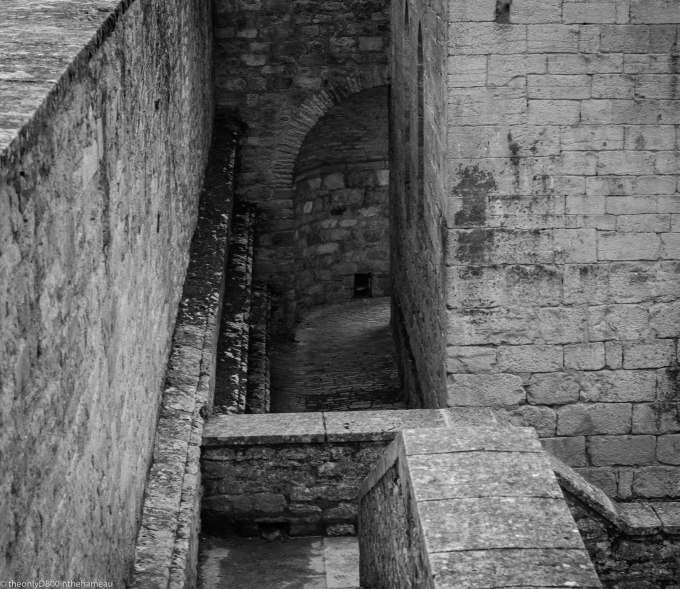
This photograph is of part of a ruined monastery (I think) in Sarlat, a medieval town in the Dordogne.
This week, Cee is looking for images of rocks. You could perhaps argue that these are stones rather than rocks, but what exactly is the difference between a stone and a rock?
Well, according to Wikipedia (so it must be true), stone is rock that’s had a bit of work done on it. Still made of rock though, I’d argue.
Judiciously cropped, as here, it reminded me of something that M C Escher might have produced.
Thursday Doors: Nohant
Posted on October 13, 2016
After last week’s post on the doors to be found at the house of George Sand, we now turn to some of the doors in the village of Nohant, in whose centre that mansion is to be found. In putting together this post, it struck me that the further away you find yourself from the big house the tattier the doors become.
Thus, right opposite the gates of the house is the village church, with this neat little side door:

And on the other side of the church is this well-kept front door:

The sign over the door is interesting, not to say intriguing when you look at it in close-up:
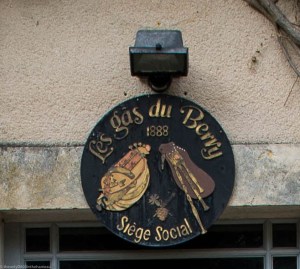
The date is 1888, ‘siège sociale‘ means headquarters and Berry is what the region was called before the country was organised into départements. The article on the right looks suspiciously like a set of bagpipes and the one on the left could be some kind of accordion, but it’s the word ‘gâs’ that’s got me stumped. It’s obviously plural (because it goes with ‘les‘), but I can’t find ‘gâ‘ in any dictionary, although ‘gas‘ (singular) is translated as ‘lad’ or ‘guy’. Perhaps it’s a patois word.
On the opposite side of what, for want of a better expression, you could call the village green, is this house which is clearly in good decorative order, as an estate agent might put it:

After that, though, things start to get a bit rough around the edges, as in this rusty gate:

And by the time we reach the edge of the village, things are much more typical of what you would expect to find in rural France:

Thursday Doors 13 October 2016
Macro Moments – Week 14: Raindrops on Roses
Posted on October 12, 2016
This week, for Musin’ with Susan’s maco challenge, here are some raindrops on roses. Don’t expect whiskers on kittens any time soon.
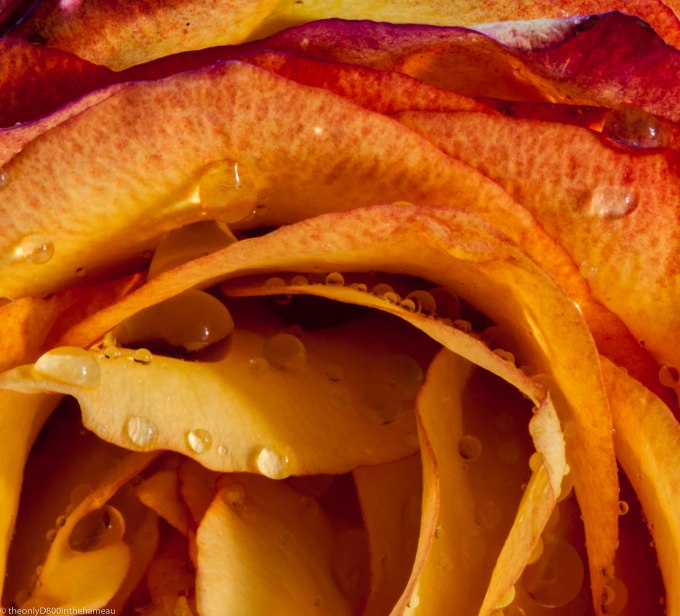
Nikon D300 with Nikkor 105mm f2.8.Macro lens. 10 sec at f4.5 ISO 200. Edited in Lightroom.
Tuesdays of Texture: Rust
Posted on October 11, 2016
These rusting chains and hoops hang over the disused well in the centre of the nearby village of Bonnefont. At a guess, the hoops once held together wooden buckets, which were lowered on the chains to collect water.

52 Weeks Photo Challenge: Week 10 – Morning
Posted on October 11, 2016
For Week 10 of her 52 Weeks Photo Challenge, The Girl That Dreams Awake has chosen the topic of ‘Morning’.
Naturally enough, ‘morning’ is often equated with ‘beginning’. When we came to France in 2004 to look for a home to buy we stayed in a gite, from the window of which I took this picture of early morning mist. So it also marks a beginning.

Weekly Photo Challenge: H2O
Posted on October 8, 2016
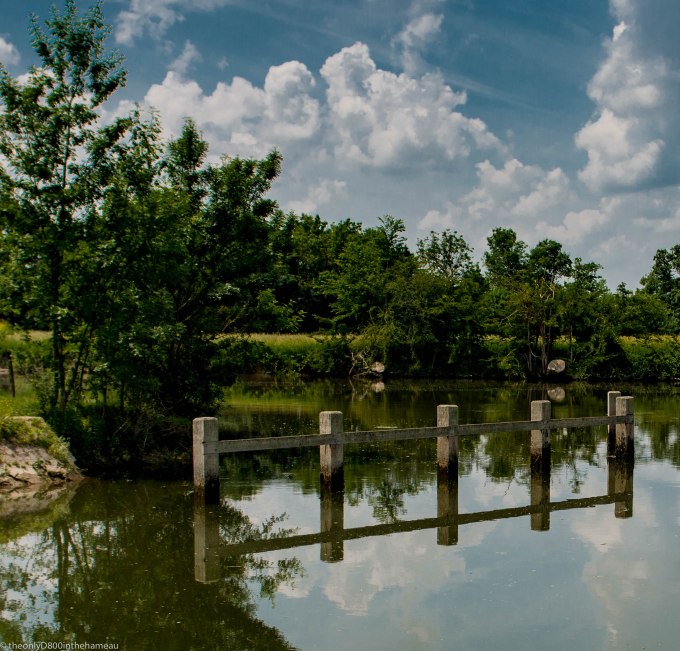
You say ‘water’, I think ‘reflections’, as in this example from the Charente River, near Chaniers.
Under pressure
Posted on October 7, 2016
As part of the wine-making process, in Bordeaux as elsewhere, the young wine has to be drawn out of the big stainless steel tanks into smaller containers under the force of gravity. Given how large the tanks are, it’s not surprising that it comes out at high pressure. That’s what you call letting it breathe.
And if you zoom in closely enough, it becomes almost abstract:

Thursday Doors: Maison de George Sand
Posted on October 6, 2016
George Sand was a noted 19th century French writer, known also for the glittering company (Chopin, Flaubert to name but two) she entertained at her house in the hamlet of Nohant, in the Indre département of central France. You can read more about her here.
Today her impressive residence is open to the public and a very popular destination for tourists and coach parties, which is how I found myself there recently. It’s got some nice doors too.
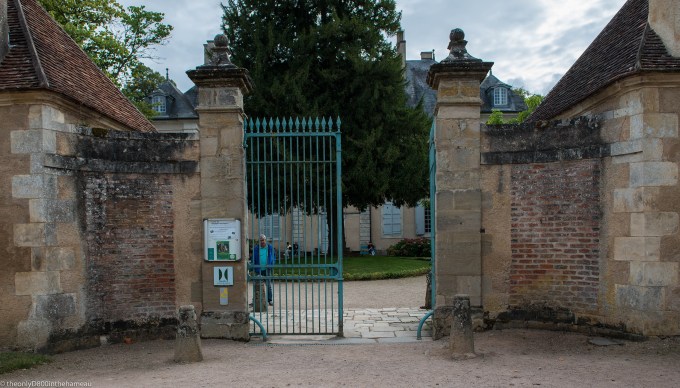
This is the gated entrance to the house; note the bricked up doors on either side:
The inevitable Gift Shop is housed in what looks like a former stable block. Not only are these doors a lovely colour but it’s unusual to see their inner side:

And here are a few more:


There is a formal garden to the side of the house. Rather incongruously, this ‘box’ of doors is plonked in the middle of the lawn. I suppose it must be art.

Thursday Doors 6 October 2016

Top Posts & Pages


 theonlyD800inthehameau